Light-force Low Friction Braces: A Patented Brackets Series
Introduction: Why Light-Force, Low Friction Mechanics Matter in Modern Orthodontics
Contemporary orthodontics increasingly prioritizes biologically efficient tooth movement, reduced patient discomfort, and shorter treatment durations. Central to achieving these goals is the optimization of frictional forces at the bracket–archwire interface. Excessive friction dissipates applied forces, necessitates higher activation loads, and can prolong treatment while increasing pain and anchorage demands. Light-force low friction braces represent an advanced evolution of straight-wire appliances, integrating patented structural modifications to reduce resistance to sliding while preserving precise three-dimensional control.
This patented bracket series (CN204293276U) introduces a comprehensive system-level approach—addressing bracket geometry, auxiliary integration, and molar anchorage design—to improve clinical efficiency without compromising biomechanics.
https://store.dentinova.co.uk/product/dlp-sla-lcd-senertek-clear-aligner-resin-dental-printer-1l/
Light-Force Low Friction Braces: Clinical Limitations of Conventional Straight-Wire Systems
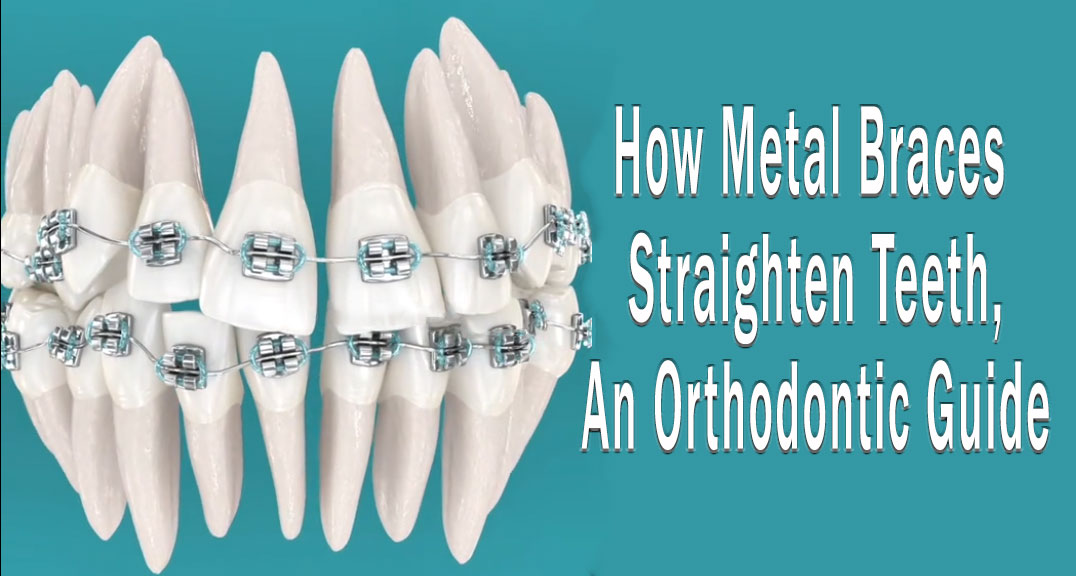
Traditional straight-wire appliances simplified orthodontic workflows by minimizing wire bending; however, several mechanical limitations persist:
High frictional resistance due to full-surface contact between flat bracket slots and straight archwires.
Limited auxiliary compatibility, particularly for vertical control, derotation, and axial corrections.
Inefficient molar configurations, where buccal tubes on both first and second molars complicate archwire insertion and replacement.
Increased force requirements, leading to patient discomfort, anchorage loss, and extended treatment timelines.
These issues highlight the need for a bracket system engineered specifically to support light-force biomechanics with reduced friction, rather than relying solely on material selection or ligation techniques.
Patented Structural Innovations in Light-Force Low Friction Braces
The light-force low-friction braces system introduces several patented design features that directly address friction and clinical inefficiencies:
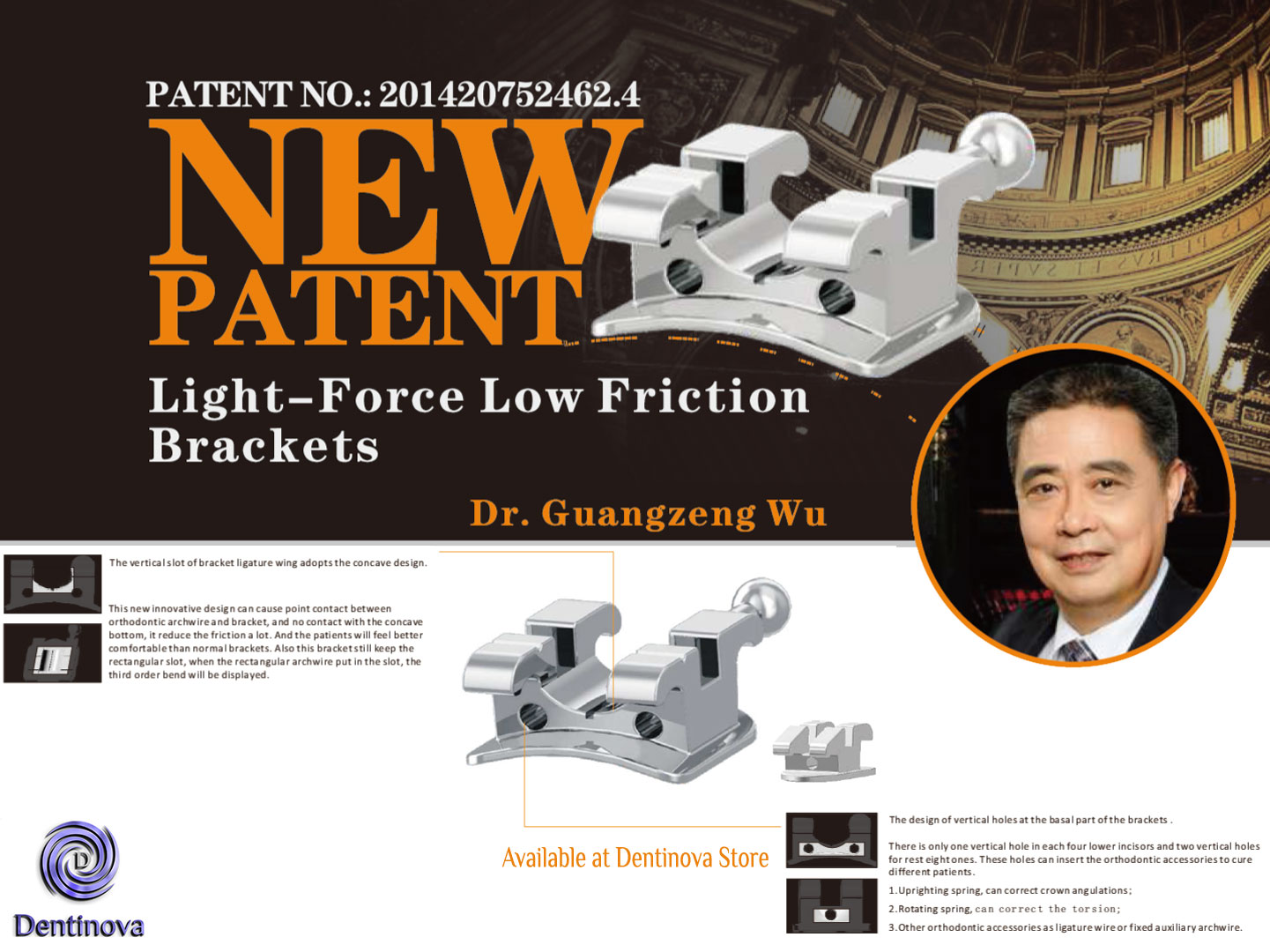
Arc-Shaped Groove for Two-Point Contact
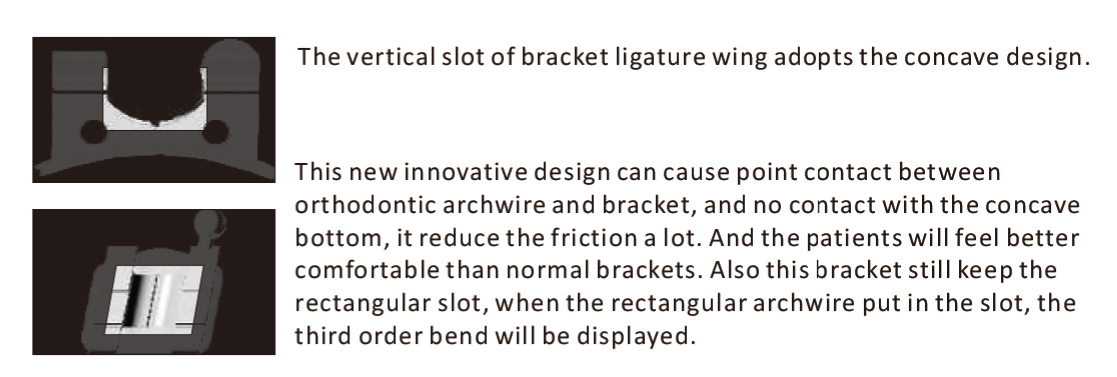
Unlike conventional flat-bottom slots, the patented brackets incorporate an arc-shaped groove at the center of the bracket slot floor. This transforms wire–slot interaction from surface contact into two-point contact, significantly reducing frictional resistance during sliding mechanics.
Optimized First Molar Bracket Design
The system replaces traditional first molar buccal tubes with a first molar bracket featuring an integrated horizontal buccal tube. This innovation:
Simplifies archwire insertion and removal
Reduces chairside time
Allows simultaneous use of anterior auxiliary arches
Reduced Friction Without Sacrificing Control
The square slot geometry is preserved for torque and angulation accuracy, while the arc-shaped groove minimizes binding and notching—achieving friction reduction without compromising prescription fidelity.
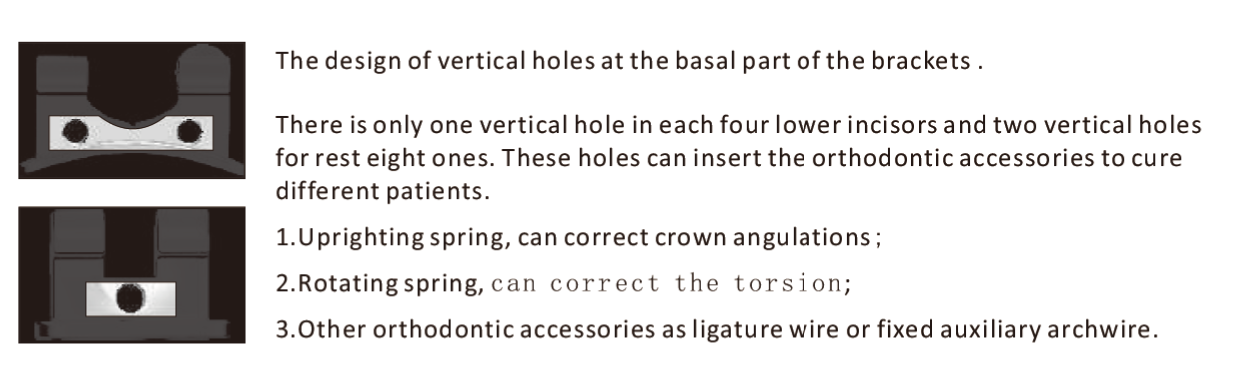
Light-Force Low Friction Braces and Integrated Orthodontic Auxiliaries
A defining advantage of light-force low-friction braces is their built-in compatibility with orthodontic auxiliaries, eliminating the need for improvised attachments.
Vertical Accessory Holes (0.3–0.5 mm)
Strategically placed vertical holes in:
Upper incisor brackets
Lower incisor brackets
Canine and premolar brackets
These allow direct insertion of:
Rotational springs
Uprighting springs
Torque auxiliaries
This design enables simultaneous alignment, derotation, and axial correction, rather than sequential mechanics.
Horizontal Buccal Tube on First Molars
The horizontal tube (0.3–1.0 mm diameter) accommodates auxiliary arches for:
Anterior intrusion
Deep bite correction
Segmental mechanics
This reduces the need for complex appliance layering and improves force efficiency.
Biomechanical Advantages of Light-Force Low Friction Braces
From a biomechanical perspective, this patented bracket system offers multiple clinically relevant benefits:
Lower force thresholds due to reduced frictional resistance
Improved force continuity, minimizing force decay during sliding
Enhanced patient comfort, with reduced pressure and soreness
Shorter treatment duration, especially in space closure and leveling phases
By enabling effective tooth movement under lighter forces, light-force low-friction brackets align closely with modern biological orthodontic principles.
Light-Force Low Friction Braces for Molar Control and Treatment Efficiency
The system’s molar configuration represents a major departure from conventional designs:
Only four molar buccal tubes are used (on second molars)
First molars receive specialized brackets, not tubes
This arrangement:
Reduces archwire insertion resistance
Improves posterior anchorage control
Facilitates auxiliary mechanics without additional bonding
The result is a streamlined posterior segment that enhances efficiency during both initial alignment and finishing phases.
Clinical Outcomes and Population-Specific Design Considerations
The patented system was developed with specific attention to Asian dental and maxillofacial morphology, but its biomechanical advantages translate universally.
Documented Clinical Benefits
Reduced friction during sliding mechanics
Faster correction of rotations and axial inclinations
Improved anterior intrusion control
Decreased overall treatment time
The bracket prescriptions and torque values are engineered to deliver predictable outcomes while maintaining aesthetic and functional harmony.
FAQ: Light-Force Low Friction Braces
1. How do light-force low-friction braces reduce friction compared to standard brackets?
They use an arc-shaped groove within the bracket slot, creating two-point contact instead of full surface contact with the archwire.
2. Can these brackets be used with standard straight archwires?
Yes. The system is compatible with conventional straight archwires while optimizing their biomechanical efficiency.
3. Are orthodontic auxiliaries required, or optional?
Auxiliaries are optional but fully supported. Vertical holes and horizontal tubes allow seamless integration when needed.
4. How does the first molar bracket differ from a traditional buccal tube?
It combines a bracket slot with an integrated horizontal tube, simplifying archwire changes and auxiliary use.
5. Do light-force low friction braces shorten treatment time?
Clinical design intent and biomechanical modeling indicate reduced treatment duration due to lower force loss and improved efficiency.
6. Is this bracket system suitable for complex cases involving rotation and inclination?
Yes. Built-in accessory ports enable simultaneous correction of rotation, torque, and axial discrepancies.
Conclusion
Light-force low-friction braces represent a patented, system-level advancement in straight-wire orthodontics. By integrating friction-reducing geometry, auxiliary-friendly architecture, and optimized molar mechanics, this bracket series addresses long-standing inefficiencies in conventional appliances. For orthodontists seeking predictable outcomes with lighter forces, improved patient comfort, and reduced treatment times, this patented bracket system offers a compelling clinical solution grounded in sound biomechanics and practical design.
Reference:
Patent no. CN204293276U : The low friction straight wire appliance of a kind of low force
Recent Articles
























Introduction: Why Light-Force, Low Friction Mechanics Matter in Modern Orthodontics
Contemporary orthodontics increasingly prioritizes biologically efficient tooth movement, reduced patient discomfort, and shorter treatment durations. Central to achieving these goals is the optimization of frictional forces at the bracket–archwire interface. Excessive friction dissipates applied forces, necessitates higher activation loads, and can prolong treatment while increasing pain and anchorage demands. Light-force low friction braces represent an advanced evolution of straight-wire appliances, integrating patented structural modifications to reduce resistance to sliding while preserving precise three-dimensional control.
This patented bracket series (CN204293276U) introduces a comprehensive system-level approach—addressing bracket geometry, auxiliary integration, and molar anchorage design—to improve clinical efficiency without compromising biomechanics.
https://store.dentinova.co.uk/product/dlp-sla-lcd-senertek-clear-aligner-resin-dental-printer-1l/
Light-Force Low Friction Braces: Clinical Limitations of Conventional Straight-Wire Systems
Traditional straight-wire appliances simplified orthodontic workflows by minimizing wire bending; however, several mechanical limitations persist:
High frictional resistance due to full-surface contact between flat bracket slots and straight archwires.
Limited auxiliary compatibility, particularly for vertical control, derotation, and axial corrections.
Inefficient molar configurations, where buccal tubes on both first and second molars complicate archwire insertion and replacement.
Increased force requirements, leading to patient discomfort, anchorage loss, and extended treatment timelines.
These issues highlight the need for a bracket system engineered specifically to support light-force biomechanics with reduced friction, rather than relying solely on material selection or ligation techniques.
Patented Structural Innovations in Light-Force Low Friction Braces
The light-force low-friction braces system introduces several patented design features that directly address friction and clinical inefficiencies:
Arc-Shaped Groove for Two-Point Contact
Unlike conventional flat-bottom slots, the patented brackets incorporate an arc-shaped groove at the center of the bracket slot floor. This transforms wire–slot interaction from surface contact into two-point contact, significantly reducing frictional resistance during sliding mechanics.
Optimized First Molar Bracket Design
The system replaces traditional first molar buccal tubes with a first molar bracket featuring an integrated horizontal buccal tube. This innovation:
Simplifies archwire insertion and removal
Reduces chairside time
Allows simultaneous use of anterior auxiliary arches
Reduced Friction Without Sacrificing Control
The square slot geometry is preserved for torque and angulation accuracy, while the arc-shaped groove minimizes binding and notching—achieving friction reduction without compromising prescription fidelity.
Light-Force Low Friction Braces and Integrated Orthodontic Auxiliaries
A defining advantage of light-force low-friction braces is their built-in compatibility with orthodontic auxiliaries, eliminating the need for improvised attachments.
Vertical Accessory Holes (0.3–0.5 mm)
Strategically placed vertical holes in:
Upper incisor brackets
Lower incisor brackets
Canine and premolar brackets
These allow direct insertion of:
Rotational springs
Uprighting springs
Torque auxiliaries
This design enables simultaneous alignment, derotation, and axial correction, rather than sequential mechanics.
Horizontal Buccal Tube on First Molars
The horizontal tube (0.3–1.0 mm diameter) accommodates auxiliary arches for:
Anterior intrusion
Deep bite correction
Segmental mechanics
This reduces the need for complex appliance layering and improves force efficiency.
Biomechanical Advantages of Light-Force Low Friction Braces
From a biomechanical perspective, this patented bracket system offers multiple clinically relevant benefits:
Lower force thresholds due to reduced frictional resistance
Improved force continuity, minimizing force decay during sliding
Enhanced patient comfort, with reduced pressure and soreness
Shorter treatment duration, especially in space closure and leveling phases
By enabling effective tooth movement under lighter forces, light-force low-friction brackets align closely with modern biological orthodontic principles.
Light-Force Low Friction Braces for Molar Control and Treatment Efficiency
The system’s molar configuration represents a major departure from conventional designs:
Only four molar buccal tubes are used (on second molars)
First molars receive specialized brackets, not tubes
This arrangement:
Reduces archwire insertion resistance
Improves posterior anchorage control
Facilitates auxiliary mechanics without additional bonding
The result is a streamlined posterior segment that enhances efficiency during both initial alignment and finishing phases.
Clinical Outcomes and Population-Specific Design Considerations
The patented system was developed with specific attention to Asian dental and maxillofacial morphology, but its biomechanical advantages translate universally.
Documented Clinical Benefits
Reduced friction during sliding mechanics
Faster correction of rotations and axial inclinations
Improved anterior intrusion control
Decreased overall treatment time
The bracket prescriptions and torque values are engineered to deliver predictable outcomes while maintaining aesthetic and functional harmony.
FAQ: Light-Force Low Friction Braces
1. How do light-force low-friction braces reduce friction compared to standard brackets?
They use an arc-shaped groove within the bracket slot, creating two-point contact instead of full surface contact with the archwire.
2. Can these brackets be used with standard straight archwires?
Yes. The system is compatible with conventional straight archwires while optimizing their biomechanical efficiency.
3. Are orthodontic auxiliaries required, or optional?
Auxiliaries are optional but fully supported. Vertical holes and horizontal tubes allow seamless integration when needed.
4. How does the first molar bracket differ from a traditional buccal tube?
It combines a bracket slot with an integrated horizontal tube, simplifying archwire changes and auxiliary use.
5. Do light-force low friction braces shorten treatment time?
Clinical design intent and biomechanical modeling indicate reduced treatment duration due to lower force loss and improved efficiency.
6. Is this bracket system suitable for complex cases involving rotation and inclination?
Yes. Built-in accessory ports enable simultaneous correction of rotation, torque, and axial discrepancies.
Conclusion
Light-force low-friction braces represent a patented, system-level advancement in straight-wire orthodontics. By integrating friction-reducing geometry, auxiliary-friendly architecture, and optimized molar mechanics, this bracket series addresses long-standing inefficiencies in conventional appliances. For orthodontists seeking predictable outcomes with lighter forces, improved patient comfort, and reduced treatment times, this patented bracket system offers a compelling clinical solution grounded in sound biomechanics and practical design.
Reference:
Patent no. CN204293276U : The low friction straight wire appliance of a kind of low force
Recent Articles
Pulsed Electromagnetic Field (PEMF) Use in Implant Dentistry
Pulsed Electromagnetic Field (PEMF) Use in Implant Dentistry Abstract and Historical Background Pulsed Electromagnetic Field (PEMF) therapy refers to the application of low-frequency electromagnetic [...]
Laser Therapy in the Management of Peri-Implantitis
Laser Therapy in the Management of Peri-Implantitis Laser technology has become an increasingly valuable adjunct in the treatment of peri-implant diseases, particularly peri-implantitis. Its [...]
Magnetically Guided Dental Nanobots (CalBots) Are Real
Magnetically Guided Dental Nanobots (CalBots) Are Real The concept of nanobots in dentistry has long been associated with futuristic speculation. However, recent peer-reviewed research [...]
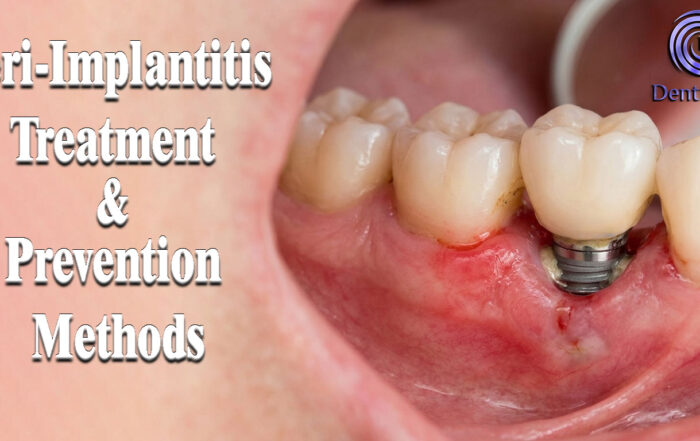
Peri-Implantitis Treatment & Prevention Methods
Peri-Implantitis Treatment & Prevention Methods Peri-implantitis remains one of the most significant biological complications affecting dental implants, posing a serious threat to long-term implant [...]
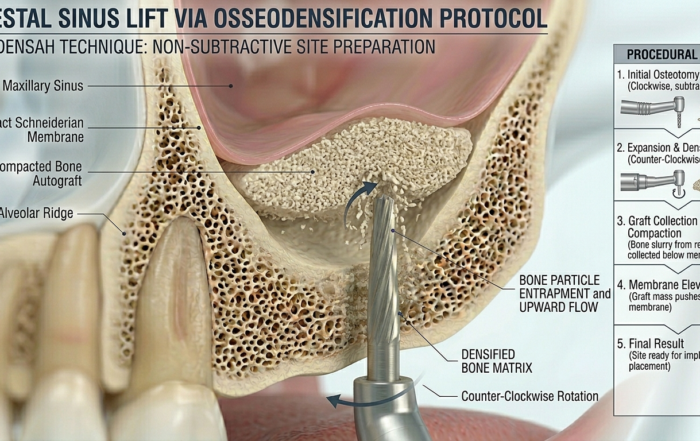
Latest Sinus Lifting Techniques in Modern Implant Dentistry
Latest Sinus Lifting Techniques in Modern Implant Dentistry A Comprehensive Clinical Review Introduction to Sinus Lifting in Implantology Sinus lifting, or maxillary sinus floor [...]
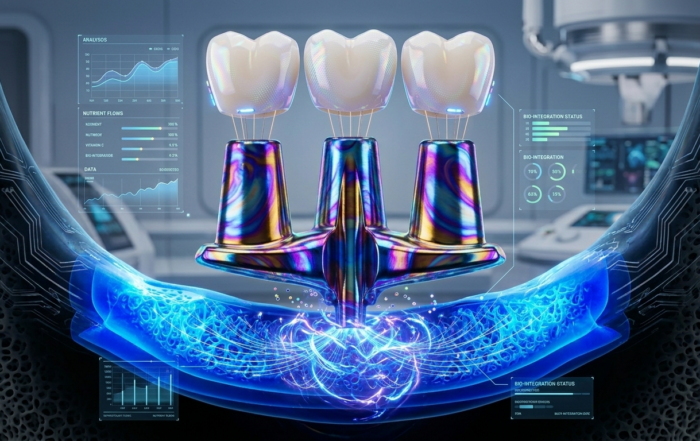
Biomechanics of the Triple Abutment & BOPiT Concept
Dental Biomechanics · Implant Science · Clinical Evidence Biomechanics of the Triple Abutment & BOPiT Concept How a saddle-shaped mathematical surface is rewriting the rules of load distribution [...]