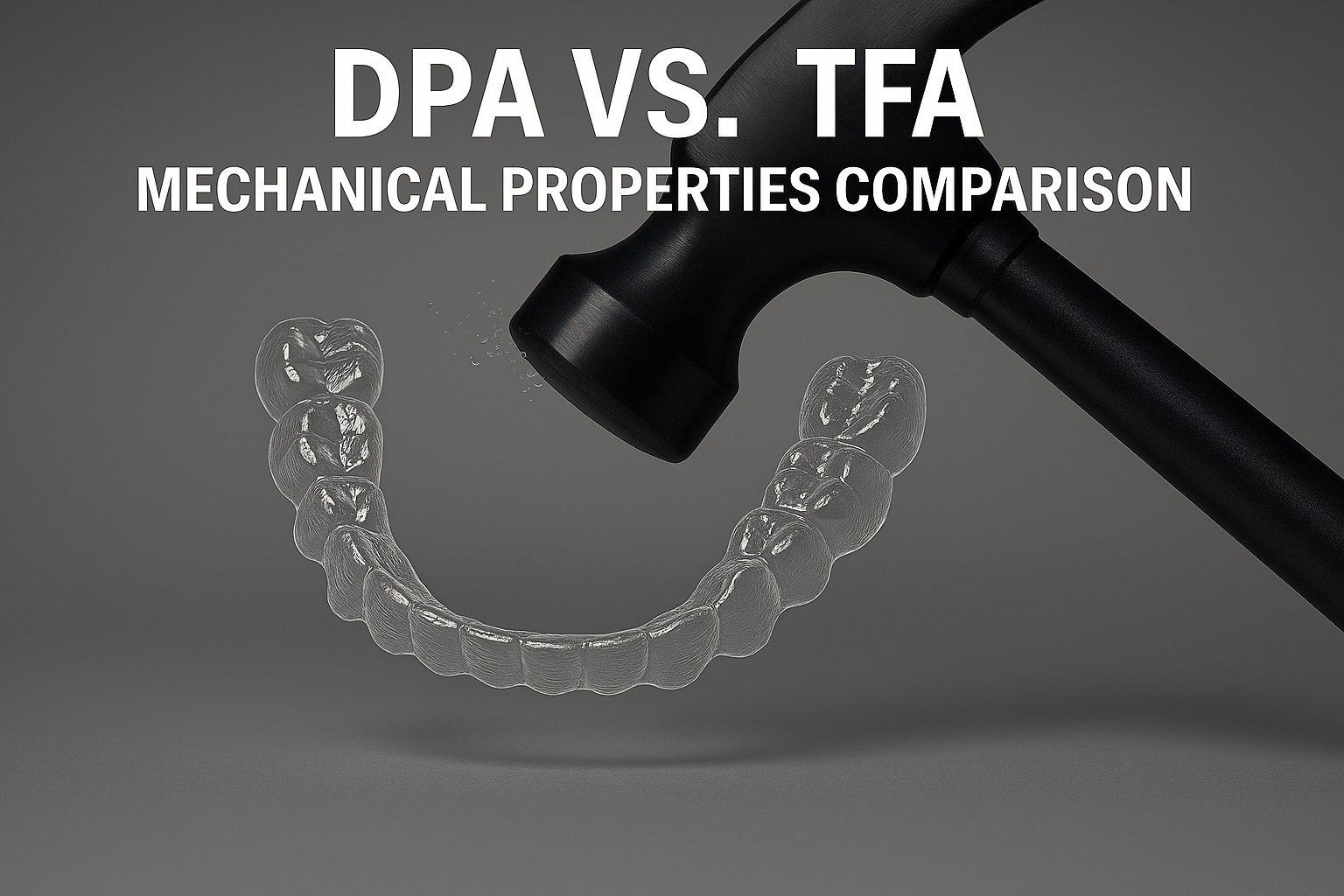
Mechanical Strength of Thermoformed VS. Direct Printed Aligners
The evolution of orthodontic aligners has seen a major shift with the introduction of 3D-printed dental aligners. While thermoformed aligners have dominated the market for decades, direct printed aligners now provide orthodontists with new possibilities in terms of strength, elasticity, and predictability. This article explores the mechanical properties of these aligners, their clinical significance, and why shape memory aligners created through orthodontic 3D printing may offer distinct advantages over traditional methods.
Mechanical Properties of Thermoformed Aligners
Thermoformed aligners are fabricated by heating a thermoplastic sheet and vacuum-forming it over a dental model. While widely used, their mechanical performance can be inconsistent due to:
Material thickness variations during fabrication
Plastic deformation under stress
Reduced elastic recovery over prolonged use
Studies have shown that thermoformed aligners often exhibit higher initial flexibility but lower long-term mechanical strength. The inconsistent elasticity can result in diminished force delivery during tooth movement, particularly in complex cases.
Advantages of Direct Printed Aligners
3D-printed aligners, also referred to as direct-printed aligners, are produced using photopolymerizable resins through precision orthodontic 3D printing. These aligners are designed to maintain consistent material thickness and geometry, offering improved mechanical properties such as:
Higher tensile strength compared to thermoformed aligners
Better elastic recovery, reducing permanent deformation
More uniform stress distribution, enhancing predictable force delivery
By using shape memory aligner technology, 3D-printed aligners can return to their original shape after minor stress, maintaining optimal fit and consistent tooth movement.
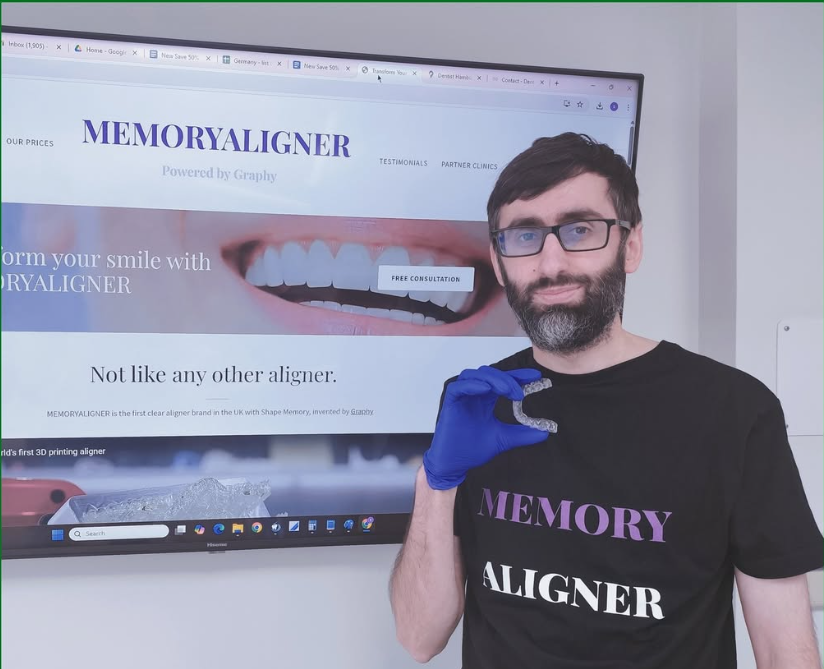
MEMORYALIGNER is the first Direct Printed Aligner Provider in Scotland

Click on the photo to contact the MEMORYALIGNER team
Force Distribution and Elasticity of Direct Printed Aligners
A key factor in orthodontic efficiency is the elasticity of the aligner material. 3D printed aligners demonstrate superior elastic behavior compared to thermoformed counterparts. Unlike thermoformed aligners, which may undergo plastic deformation under prolonged load, direct printed aligners can apply consistent force throughout the treatment cycle.
This characteristic ensures that:
Tooth movement occurs more predictably
Treatment duration may be reduced
Patients experience a more comfortable, controlled force application
Shape memory aligners further enhance this effect, as their resilience allows them to maintain their intended force vectors even after repeated wear.
Dimensional Accuracy and Mechanical Strength
One of the most critical advantages of 3D printed dental aligners is their dimensional accuracy. Studies comparing thermoformed and printed aligners demonstrate that direct printed aligners can:
Achieve a more precise fit to the digital model
Reduce undesired gaps that compromise force efficiency
Maintain consistent thickness across all aligner surfaces
The combination of mechanical strength and accuracy ensures that orthodontists can rely on orthodontic 3D printing to produce aligners that exert consistent, clinically effective forces.
Clinical Implications for Orthodontists
For clinicians, the mechanical superiority of 3D-printed aligners translates to several tangible benefits:
Predictable Tooth Movement: The uniform strength and elasticity improve the control of forces applied to each tooth.
Reduced Material Fatigue: Direct printed aligners resist permanent deformation, preserving treatment integrity over time.
Optimized Treatment Planning: The precision of 3D printed dental aligners allows orthodontists to plan complex movements with confidence.
Patient Comfort: Improved elasticity and consistent force reduce discomfort associated with sudden or excessive pressure.
Overall, integrating direct printed aligners into clinical practice allows orthodontists to provide patients with efficient, reliable, and comfortable clear aligner therapy.
This comparison highlights why orthodontic 3D printing is increasingly favored among specialist orthodontists who require precise, predictable results.
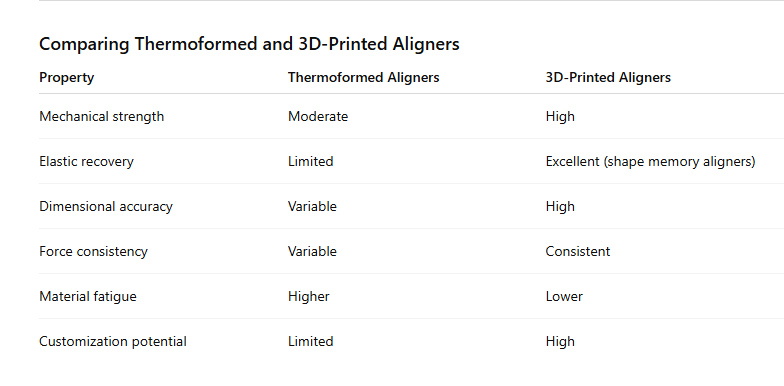
Comparing Thermoformed and 3D-Printed Aligners
Direct printed aligner vs. thermoforming aligners-Comparing Thermoformed and 3D-Printed Aligners
DPA VS. TFA From The Sustainability Point of View
From a sustainability and carbon footprint perspective, directly printed aligners (DPA) demonstrate a clear environmental advantage over thermoformed aligners (TFA). Traditional thermoforming relies on the production of resin dental models for each stage, generating significant non-recyclable waste and consuming large amounts of energy. In contrast, the 3D printing process for DPA eliminates the need for intermediary resin models, leading to a substantial reduction in material usage and manufacturing waste. Furthermore, the streamlined production workflow of direct printed aligners consumes less electricity and raw material, contributing to a lower overall carbon footprint. As global industries prioritize eco-responsibility, adopting orthodontic 3D printing aligns with broader sustainability goals by minimizing waste and promoting resource efficiency. With future advances in recyclable photopolymer resins, 3D printed dental aligners are expected to further enhance environmental performance, making them a more sustainable and forward-thinking alternative to conventional thermoformed aligners.
Exclusive Offer for UK Orthodontists and GPs
Transform your clear aligner practice with two premium solutions designed for precision and clinical efficiency.
We proudly present MEMORYALIGNER™ — the first direct printed aligner brand in the UK, offering superior accuracy, shape memory performance, and sustainable production through advanced orthodontic 3D printing. For clinicians who prefer traditional methods, our Dentinova Thermoformed Aligners deliver proven reliability and consistent results supported by years of expertise in digital orthodontics.
To help you explore both technologies, we’re offering a free personalized consultation exclusively for UK orthodontists and general practitioners. Our digital orthodontic team will guide you through the full process — from treatment planning to aligner manufacturing — helping you choose the optimal system for your practice.
📩 Book your free consultation today and experience how MEMORYALIGNER™ and Dentinova can elevate your orthodontic outcomes while streamlining your workflow.

FAQs
Q1: Are 3D-printed aligners stronger than thermoformed aligners?
Yes. Studies indicate that direct printed aligners offer higher tensile strength and better elastic recovery than traditional thermoformed aligners.
Q2: What are shape memory aligners?
Shape memory aligners are 3D-printed aligners that return to their original shape after minor stress, maintaining consistent force for effective tooth movement.
Q3: Can 3D-printed dental aligners reduce treatment time?
Yes. The mechanical consistency and precision of 3D-printed aligners allow for more predictable tooth movement, potentially shortening treatment duration.
Q4: Are 3D-printed aligners suitable for complex orthodontic cases?
Absolutely. Their uniform strength, elasticity, and fit make them suitable for precise control even in complex movements.
Q5: How does orthodontic 3D printing improve patient comfort?
By providing consistent force and reducing material fatigue, 3D-printed aligners minimize excessive pressure and discomfort.
References













The evolution of orthodontic aligners has seen a major shift with the introduction of 3D-printed dental aligners. While thermoformed aligners have dominated the market for decades, direct printed aligners now provide orthodontists with new possibilities in terms of strength, elasticity, and predictability. This article explores the mechanical properties of these aligners, their clinical significance, and why shape memory aligners created through orthodontic 3D printing may offer distinct advantages over traditional methods.
Mechanical Properties of Thermoformed Aligners
Thermoformed aligners are fabricated by heating a thermoplastic sheet and vacuum-forming it over a dental model. While widely used, their mechanical performance can be inconsistent due to:
Material thickness variations during fabrication
Plastic deformation under stress
Reduced elastic recovery over prolonged use
Studies have shown that thermoformed aligners often exhibit higher initial flexibility but lower long-term mechanical strength. The inconsistent elasticity can result in diminished force delivery during tooth movement, particularly in complex cases.
Advantages of Direct Printed Aligners
3D-printed aligners, also referred to as direct-printed aligners, are produced using photopolymerizable resins through precision orthodontic 3D printing. These aligners are designed to maintain consistent material thickness and geometry, offering improved mechanical properties such as:
Higher tensile strength compared to thermoformed aligners
Better elastic recovery, reducing permanent deformation
More uniform stress distribution, enhancing predictable force delivery
By using shape memory aligner technology, 3D-printed aligners can return to their original shape after minor stress, maintaining optimal fit and consistent tooth movement.
MEMORYALIGNER is the first Direct Printed Aligner Provider in Scotland
Click on the photo to contact the MEMORYALIGNER team
Force Distribution and Elasticity of Direct Printed Aligners
A key factor in orthodontic efficiency is the elasticity of the aligner material. 3D printed aligners demonstrate superior elastic behavior compared to thermoformed counterparts. Unlike thermoformed aligners, which may undergo plastic deformation under prolonged load, direct printed aligners can apply consistent force throughout the treatment cycle.
This characteristic ensures that:
Tooth movement occurs more predictably
Treatment duration may be reduced
Patients experience a more comfortable, controlled force application
Shape memory aligners further enhance this effect, as their resilience allows them to maintain their intended force vectors even after repeated wear.
Dimensional Accuracy and Mechanical Strength
One of the most critical advantages of 3D printed dental aligners is their dimensional accuracy. Studies comparing thermoformed and printed aligners demonstrate that direct printed aligners can:
Achieve a more precise fit to the digital model
Reduce undesired gaps that compromise force efficiency
Maintain consistent thickness across all aligner surfaces
The combination of mechanical strength and accuracy ensures that orthodontists can rely on orthodontic 3D printing to produce aligners that exert consistent, clinically effective forces.
Clinical Implications for Orthodontists
For clinicians, the mechanical superiority of 3D-printed aligners translates to several tangible benefits:
Predictable Tooth Movement: The uniform strength and elasticity improve the control of forces applied to each tooth.
Reduced Material Fatigue: Direct printed aligners resist permanent deformation, preserving treatment integrity over time.
Optimized Treatment Planning: The precision of 3D printed dental aligners allows orthodontists to plan complex movements with confidence.
Patient Comfort: Improved elasticity and consistent force reduce discomfort associated with sudden or excessive pressure.
Overall, integrating direct printed aligners into clinical practice allows orthodontists to provide patients with efficient, reliable, and comfortable clear aligner therapy.
This comparison highlights why orthodontic 3D printing is increasingly favored among specialist orthodontists who require precise, predictable results.
Comparing Thermoformed and 3D-Printed Aligners
Direct printed aligner vs. thermoforming aligners-Comparing Thermoformed and 3D-Printed Aligners
DPA VS. TFA From The Sustainability Point of View
From a sustainability and carbon footprint perspective, directly printed aligners (DPA) demonstrate a clear environmental advantage over thermoformed aligners (TFA). Traditional thermoforming relies on the production of resin dental models for each stage, generating significant non-recyclable waste and consuming large amounts of energy. In contrast, the 3D printing process for DPA eliminates the need for intermediary resin models, leading to a substantial reduction in material usage and manufacturing waste. Furthermore, the streamlined production workflow of direct printed aligners consumes less electricity and raw material, contributing to a lower overall carbon footprint. As global industries prioritize eco-responsibility, adopting orthodontic 3D printing aligns with broader sustainability goals by minimizing waste and promoting resource efficiency. With future advances in recyclable photopolymer resins, 3D printed dental aligners are expected to further enhance environmental performance, making them a more sustainable and forward-thinking alternative to conventional thermoformed aligners.
Exclusive Offer for UK Orthodontists and GPs
Transform your clear aligner practice with two premium solutions designed for precision and clinical efficiency.
We proudly present MEMORYALIGNER™ — the first direct printed aligner brand in the UK, offering superior accuracy, shape memory performance, and sustainable production through advanced orthodontic 3D printing. For clinicians who prefer traditional methods, our Dentinova Thermoformed Aligners deliver proven reliability and consistent results supported by years of expertise in digital orthodontics.
To help you explore both technologies, we’re offering a free personalized consultation exclusively for UK orthodontists and general practitioners. Our digital orthodontic team will guide you through the full process — from treatment planning to aligner manufacturing — helping you choose the optimal system for your practice.
📩 Book your free consultation today and experience how MEMORYALIGNER™ and Dentinova can elevate your orthodontic outcomes while streamlining your workflow.
FAQs
Q1: Are 3D-printed aligners stronger than thermoformed aligners?
Yes. Studies indicate that direct printed aligners offer higher tensile strength and better elastic recovery than traditional thermoformed aligners.
Q2: What are shape memory aligners?
Shape memory aligners are 3D-printed aligners that return to their original shape after minor stress, maintaining consistent force for effective tooth movement.
Q3: Can 3D-printed dental aligners reduce treatment time?
Yes. The mechanical consistency and precision of 3D-printed aligners allow for more predictable tooth movement, potentially shortening treatment duration.
Q4: Are 3D-printed aligners suitable for complex orthodontic cases?
Absolutely. Their uniform strength, elasticity, and fit make them suitable for precise control even in complex movements.
Q5: How does orthodontic 3D printing improve patient comfort?
By providing consistent force and reducing material fatigue, 3D-printed aligners minimize excessive pressure and discomfort.