Photogrammetry in Full-Arch Implant Restoration
Precision-Driven Digital Workflow for Modern Dental Surgeons
Introduction: Why Photogrammetry Matters in Full-Arch Dentistry
Full-arch implant rehabilitation demands absolute precision. Even minimal discrepancies in implant position transfer can lead to prosthetic misfit, screw loosening, stress accumulation, and long-term biological or mechanical complications.
Photogrammetry has emerged as a gold-standard digital solution for accurately capturing implant positions in full-arch cases, surpassing conventional impressions and even intraoral scanners in multi-implant scenarios. By converting calibrated photographs into ultra-accurate 3D spatial data, photogrammetry enables passive fit, predictable prosthetics, and streamlined chairside and laboratory workflows.
For dental surgeons specializing in All-on-4®, All-on-6®, and full-arch fixed implant restorations, photogrammetry is no longer optional—it is a competitive and clinical advantage.
What Is Photogrammetry in Dental Implantology?
Photogrammetry is the science of extracting precise three-dimensional measurements from multiple overlapping photographs. In implant dentistry, it is used to determine the exact spatial coordinates of implant platforms using scan bodies or coded markers.
Unlike conventional impressions or intraoral scanning—both of which accumulate distortion over long spans—photogrammetry captures implant positions without stitching errors, making it exceptionally suitable for full-arch restorations.
Key Dental Advantage
Photogrammetry measures implant position, angulation, and inter-implant relationships independently of soft tissue, ensuring prosthetic accuracy even in complex edentulous arches.
Clinical Applications of Photogrammetry for Full-Arch Cases
While photogrammetry is widely used across multiple industries, its most transformative impact in dentistry is seen in implant prosthodontics.
Primary Dental Uses
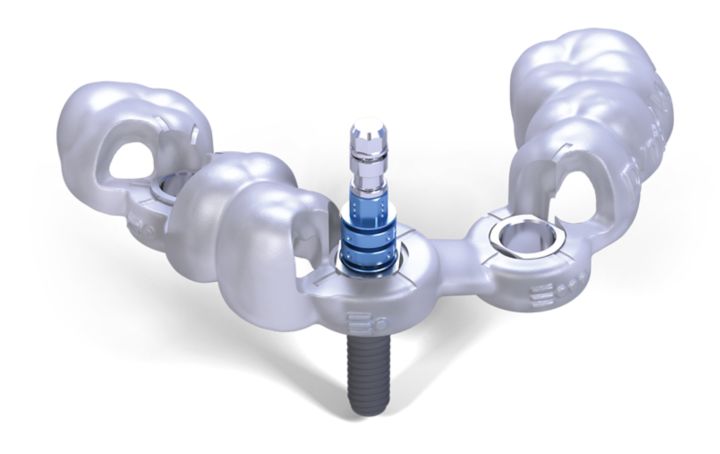
Full-arch implant position capture (All-on-X cases)
Verification of implant parallelism and divergence
Passive fit framework fabrication
Immediate loading protocols
Titanium and zirconia full-arch prostheses
Hybrid prosthetic frameworks
CAD/CAM verification jigs
Digital cross-arch accuracy validation
Why Full-Arch Surgeons Prefer Photogrammetry
Eliminates impression material distortion
Avoids intraoral scanner stitching errors
Superior accuracy over long spans
Faster chairside acquisition
Reduced remake rates
Predictable lab outcomes
How Dental Photogrammetry Works: Step-by-Step Clinical Workflow
Step 1: Image Acquisition (Clinical Stage)
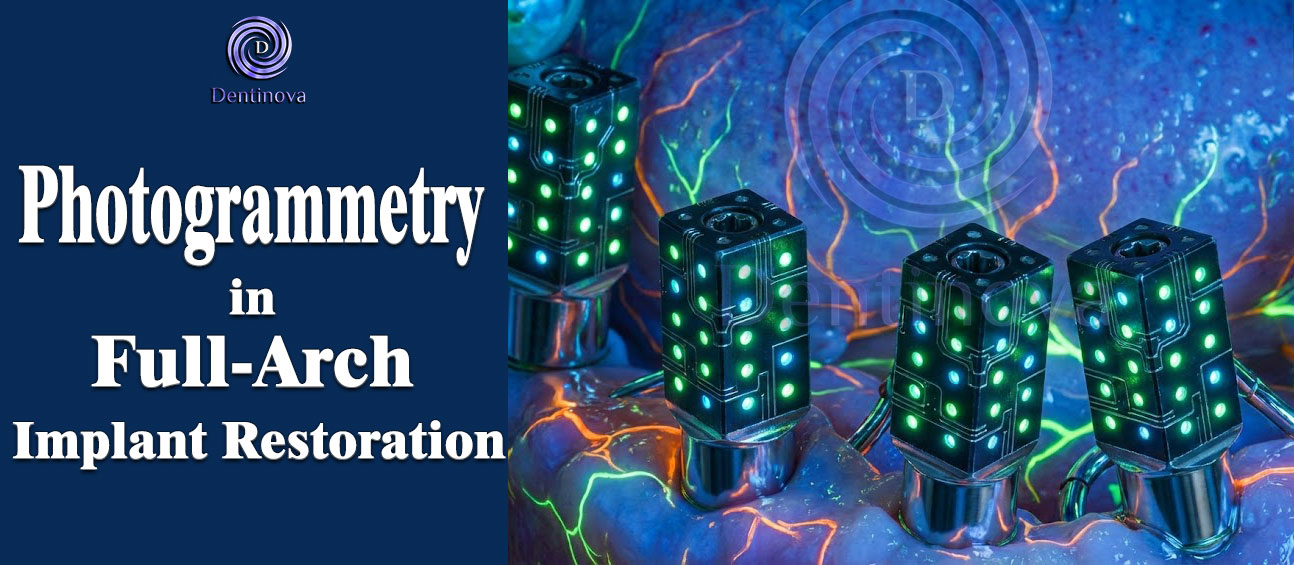
A calibrated photogrammetry camera system captures multiple synchronized images of implant scan bodies or coded markers placed intraorally.
Clinical Best Practices
Use manufacturer-specific scan bodies or coded markers
Ensure complete seating and torque verification
Maintain dry, matte surfaces (powdering rarely required)
Capture images circumferentially across the arch
Avoid patient movement during acquisition
Unlike conventional photography, dental photogrammetry systems are optimized for sub-micron accuracy, not aesthetics.
Step 2: Data Processing and Upload
Captured images are processed by proprietary photogrammetry software, which identifies reference markers and calculates implant coordinates using triangulation algorithms.
The software automatically:
Recognizes coded scan bodies
Computes 3D implant positions
Generates a highly accurate digital implant file
Exports data compatible with CAD/CAM systems
No manual alignment or stitching is required.
Step 3: 3D Reconstruction and Implant Coordinate Mapping
Using Structure-from-Motion (SfM) principles, the software reconstructs a digital implant framework reference model.
Key Technical Processes
Feature recognition across images
Geometric verification to eliminate errors
Triangulation of implant positions
Creation of a distortion-free reference dataset
This data serves as the foundation for prosthetic CAD design, ensuring passive fit even across 6–8 implants.
Photogrammetry vs Intraoral Scanning in Full-Arch Cases
| Aspect | Photogrammetry | Intraoral Scanner |
|---|---|---|
| Cross-arch accuracy | Excellent | Limited |
| Stitching errors | None | Cumulative |
| Soft tissue dependency | No | Yes |
| Full-arch reliability | High | Variable |
| Passive fit frameworks | Predictable | Less predictable |
Clinical takeaway:
In full-arch restorations, photogrammetry consistently outperforms intraoral scanners in accuracy and repeatability.
Software and Systems Commonly Used in Dental Photogrammetry
Dental-specific photogrammetry systems integrate both hardware and software, unlike general industrial platforms.
Common Dental-Focused Solutions
iCam4D
PIC Dental
Shining 3D photogrammetry systems
ImplaMet
Dental-specific Metashape workflows (lab use)
These systems export data directly into:
Exocad
3Shape
Dental Wings
Blender for Dental
Other CAD platforms
Post-Processing and CAD Integration
Once implant coordinates are generated:
Data is imported into CAD software
Frameworks are designed without verification jigs
Passive fit is achieved digitally
Milling or printing proceeds with confidence
For dental surgeons, this translates into:
Fewer try-ins
Shorter delivery times
Reduced lab remakes
Higher patient satisfaction
Case Impact: Photogrammetry in Full-Arch Prosthetic Accuracy
Clinical studies and real-world experience consistently show:
Improved passive fit
Reduced screw loosening
Lower framework stress
Increased long-term prosthetic success
Photogrammetry is especially valuable in:
Tilted implants
Zygomatic or pterygoid implants
Immediate full-arch loading
Long-span titanium frameworks
Conclusion: A New Standard for Full-Arch Implant Dentistry
Photogrammetry has transitioned from an advanced digital option to a clinical necessity for full-arch implant surgeons. Its unmatched accuracy, efficiency, and reliability make it the preferred solution for predictable prosthetic outcomes.
For dental surgeons committed to excellence in full-arch rehabilitation, photogrammetry represents the convergence of digital precision and clinical confidence—delivering restorations that fit passively, function optimally, and last long-term.
Recent Articles






















Precision-Driven Digital Workflow for Modern Dental Surgeons
Introduction: Why Photogrammetry Matters in Full-Arch Dentistry
Full-arch implant rehabilitation demands absolute precision. Even minimal discrepancies in implant position transfer can lead to prosthetic misfit, screw loosening, stress accumulation, and long-term biological or mechanical complications.
Photogrammetry has emerged as a gold-standard digital solution for accurately capturing implant positions in full-arch cases, surpassing conventional impressions and even intraoral scanners in multi-implant scenarios. By converting calibrated photographs into ultra-accurate 3D spatial data, photogrammetry enables passive fit, predictable prosthetics, and streamlined chairside and laboratory workflows.
For dental surgeons specializing in All-on-4®, All-on-6®, and full-arch fixed implant restorations, photogrammetry is no longer optional—it is a competitive and clinical advantage.
What Is Photogrammetry in Dental Implantology?
Photogrammetry is the science of extracting precise three-dimensional measurements from multiple overlapping photographs. In implant dentistry, it is used to determine the exact spatial coordinates of implant platforms using scan bodies or coded markers.
Unlike conventional impressions or intraoral scanning—both of which accumulate distortion over long spans—photogrammetry captures implant positions without stitching errors, making it exceptionally suitable for full-arch restorations.
Key Dental Advantage
Photogrammetry measures implant position, angulation, and inter-implant relationships independently of soft tissue, ensuring prosthetic accuracy even in complex edentulous arches.
Clinical Applications of Photogrammetry for Full-Arch Cases
While photogrammetry is widely used across multiple industries, its most transformative impact in dentistry is seen in implant prosthodontics.
Primary Dental Uses
Full-arch implant position capture (All-on-X cases)
Verification of implant parallelism and divergence
Passive fit framework fabrication
Immediate loading protocols
Titanium and zirconia full-arch prostheses
Hybrid prosthetic frameworks
CAD/CAM verification jigs
Digital cross-arch accuracy validation
Why Full-Arch Surgeons Prefer Photogrammetry
Eliminates impression material distortion
Avoids intraoral scanner stitching errors
Superior accuracy over long spans
Faster chairside acquisition
Reduced remake rates
Predictable lab outcomes
How Dental Photogrammetry Works: Step-by-Step Clinical Workflow
Step 1: Image Acquisition (Clinical Stage)
A calibrated photogrammetry camera system captures multiple synchronized images of implant scan bodies or coded markers placed intraorally.
Clinical Best Practices
Use manufacturer-specific scan bodies or coded markers
Ensure complete seating and torque verification
Maintain dry, matte surfaces (powdering rarely required)
Capture images circumferentially across the arch
Avoid patient movement during acquisition
Unlike conventional photography, dental photogrammetry systems are optimized for sub-micron accuracy, not aesthetics.
Step 2: Data Processing and Upload
Captured images are processed by proprietary photogrammetry software, which identifies reference markers and calculates implant coordinates using triangulation algorithms.
The software automatically:
Recognizes coded scan bodies
Computes 3D implant positions
Generates a highly accurate digital implant file
Exports data compatible with CAD/CAM systems
No manual alignment or stitching is required.
Step 3: 3D Reconstruction and Implant Coordinate Mapping
Using Structure-from-Motion (SfM) principles, the software reconstructs a digital implant framework reference model.
Key Technical Processes
Feature recognition across images
Geometric verification to eliminate errors
Triangulation of implant positions
Creation of a distortion-free reference dataset
This data serves as the foundation for prosthetic CAD design, ensuring passive fit even across 6–8 implants.
Photogrammetry vs Intraoral Scanning in Full-Arch Cases
| Aspect | Photogrammetry | Intraoral Scanner |
|---|---|---|
| Cross-arch accuracy | Excellent | Limited |
| Stitching errors | None | Cumulative |
| Soft tissue dependency | No | Yes |
| Full-arch reliability | High | Variable |
| Passive fit frameworks | Predictable | Less predictable |
Clinical takeaway:
In full-arch restorations, photogrammetry consistently outperforms intraoral scanners in accuracy and repeatability.
Software and Systems Commonly Used in Dental Photogrammetry
Dental-specific photogrammetry systems integrate both hardware and software, unlike general industrial platforms.
Common Dental-Focused Solutions
iCam4D
PIC Dental
Shining 3D photogrammetry systems
ImplaMet
Dental-specific Metashape workflows (lab use)
These systems export data directly into:
Exocad
3Shape
Dental Wings
Blender for Dental
Other CAD platforms
Post-Processing and CAD Integration
Once implant coordinates are generated:
Data is imported into CAD software
Frameworks are designed without verification jigs
Passive fit is achieved digitally
Milling or printing proceeds with confidence
For dental surgeons, this translates into:
Fewer try-ins
Shorter delivery times
Reduced lab remakes
Higher patient satisfaction
Case Impact: Photogrammetry in Full-Arch Prosthetic Accuracy
Clinical studies and real-world experience consistently show:
Improved passive fit
Reduced screw loosening
Lower framework stress
Increased long-term prosthetic success
Photogrammetry is especially valuable in:
Tilted implants
Zygomatic or pterygoid implants
Immediate full-arch loading
Long-span titanium frameworks
Conclusion: A New Standard for Full-Arch Implant Dentistry
Photogrammetry has transitioned from an advanced digital option to a clinical necessity for full-arch implant surgeons. Its unmatched accuracy, efficiency, and reliability make it the preferred solution for predictable prosthetic outcomes.
For dental surgeons committed to excellence in full-arch rehabilitation, photogrammetry represents the convergence of digital precision and clinical confidence—delivering restorations that fit passively, function optimally, and last long-term.